WELCOME TO YOUR AND MY PERSPECTIVE!!
Welcome..and enjoy my blog. I hope you can be of our family because it's KAMPOENG!!
KAMPOENG is "village" at countryside in the meaning of Indonesian Languange.
KAMPOENG is "village" at countryside in the meaning of Indonesian Languange.
Our Concept is "One Million Simple Small Act is Better Than One Big Complicated Act"

Thursday, June 5, 2008


Save Turtle Around The World!

Sea turtles (Superfamily Chelonioidea) are turtles found in all the world's oceans except the Arctic Ocean. There are seven living species of sea turtles: flatback, green, hawksbill, Kemp's Ridley, leatherback, loggerhead and olive ridley. The East Pacific subpopulation of the green turtle was previously classified as a separate species, the black turtle, but DNA evidence indicates that it is not evolutionarily distinct from the green turtle. All species except the leatherback are in the family Cheloniidae; the leatherback belongs to the family Dermochelyidae and is its only member.

Marine turtles are caught worldwide, despite it being illegal to hunt most of the species in many countries. A great deal of intentional marine turtle harvests worldwide are for the food industry. In many parts of the world, the flesh of sea turtles are considered fine dining. Historically, many coastal communities around the world have depended on sea turtles as a source of protein. Several turtles could be harvested at once and kept alive on their backs for months until needed. The skin of the flippers are also prized for use as shoes and assorted leather-goods. To a much lesser extent, specific species of marine turtles are targeted not for their flesh, but for their shells. Tortoiseshell, a traditional decorative ornamental material used in Japan and China, is derived from the carapace scutes of the hawksbill turtle.
Sea turtles play key roles in two ecosystems that are critical to them as well as to humans—the oceans and beaches/dunes. If sea turtles were to become extinct, the negative impact on beaches and the oceans would potentially be significant.
In the oceans, for example, sea turtles, especially green sea turtles, are one of the very few creatures (manatees are another) that eat a type of vegetation called sea grass that grows on the sea floor. Sea grass must be kept short to remain healthy, and beds of healthy sea grass are essential breeding and development areas for many species of fish and other marine life. A decline or loss of sea grass beds would mean a loss of the marine species that directly depend on the beds, which would trigger a chain reaction and negatively impact marine and human life. When one part of an ecosystem is destroyed, the other parts will follow.
Beaches and dunes are a fragile ecosystem that does not get many nutrients to support its vegetation, which is needed to help prevent erosion. Sea turtles contribute nutrients to dune vegetation from their eggs. Every year, sea turtles lay countless numbers of eggs in beaches during nesting season. Along one twenty-mile (32 km) stretch of beach in Florida alone, for example, more than 150,000 pounds of eggs are laid each year. Nutrients from hatched eggs as well as from eggs that never hatch and from hatchlings that fail to make it into the ocean are all sources of nutrients for dune vegetation. A decline in the number of sea turtles means fewer eggs laid, less nutrients for the sand dunes and its vegetation, and a higher risk for beach erosion.
There is a news from Greenpeace web,
Bhubaneshwar , India — With turtle mortalities due to illegal fishing spiralling out of control, Greenpeace today presented the Orissa government with a clear ‘upper limit’ target for turtle mortality along the coast from Paradip to Chilika. Criticising the government for failing to solve a recurring tragedy, Greenpeace demanded that the funds recently released by the Centre be utilised to undertake effective patrolling to prevent illegal trawling. As of 31st January, 2,970 turtle carcasses have been counted along this stretch of the coast. Greenpeace is challenging the government to reduce the current rate of turtle mortalities by 20%, at the very least until the end of April 2008.
“Even though the resources are now available, it is ironic that the turtle toll until January 31 is almost 3000 in the Paradip–Chilika stretch, a dramatic 76% increase from the average of the previous four turtle seasons. While reducing mortality to zero might not be practical, it is high time the Government of Orissa demonstrates its commitment to protecting its turtles, by setting itself, progressively depreciating annual turtle mortality reduction targets. It must start with what is left of this turtle season. This benchmark would enable the Government’s turtle protection efforts to be evaluated in an objective manner” said Sanjiv Gopal, Oceans Campaigner, Greenpeace India.
Illegal fishing and especially trawling has resulted in the death of over 100,000 turtles over the last decade. Even as illegal fishing in the Devi area continues unabated, the situation in the Gahirmatha Marine Sanctuary remains unknown, with no independent verification of official figures possible. Further, the government is not open to joint efforts on monitoring the mortality of turtles in collaboration with conservation groups and NGOs, as this would reveal shocking levels of turtle casualties on the Orissa coast. While the Government has maintained that annual mortalities from the last three seasons has not exceeded 4000, estimates from several independent agencies place this at a range above 10,000 for every season.
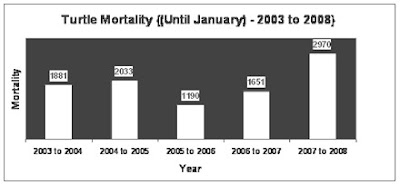
Greenpeace has been monitoring the situation in the current turtle season (2007-2008), from November 2007, to ensure that the resources made available to the Department of Forests and Wildlife are utilized appropriately and effectively. From evidence gathered until January 2008, it is clear that inspite of the required resources being made available, the Government of Orissa is once again failing in it’s responsibility to protect the turtles that throng Orissa’s coastal waters, every year from November to May.
The turtle death toll, along the Paradip to Chilika coast, has already crossed 3000 turtles (until January 31, 2008). Illegal fishing in the Devi area, especially trawling, continues unabated. The situation in the Gahirmatha Marine Sanctuary remains unknown, with no independent verification of official figures possible.
This is greenpeace's act. As a first step, to demonstrate commitment and accountability, towards resources which have been made available to ensure effective patrolling and reduction in the mortalities of turtles from mechanised fisheries and especially trawling, Greenpeace is calling the Government of Orissa and the Department of Forests and Wildlife in particular
• To put in place mechanisms, which would include regular marine patrolling, to ensure that the current rate of mortalities in the Devi region, are reduced.
• By way of an objective evaluation of these efforts, this would imply that the mortalities of Olive Ridley turtles in the devi region does not exceed 3760 for the current season, until April 2008, the current figure until January 2008 being 2970.
• This would mean that the mortality for February, March and April 2008 does not exceed 790 or a drop in mortality by 21%.
As part of it’s ongoing campaign to protect the Olive Ridley Turtles, and the interests of traditional fisher communities, Greenpeace will continue to monitor the situation and await to see how the Government of Orissa responds to this challenge positively, before taking any further action.
Please if you care about conservation of sea turtle, visit greenpeace official website. You can send letter or e-mail to Government of Orissa to support marine conservation and protection for sea turtles. Sea turtles are just not animal, but its are part of our world.
The turtle death toll, along the Paradip to Chilika coast, has already crossed 3000 turtles (until January 31, 2008). Illegal fishing in the Devi area, especially trawling, continues unabated. The situation in the Gahirmatha Marine Sanctuary remains unknown, with no independent verification of official figures possible.
This is greenpeace's act. As a first step, to demonstrate commitment and accountability, towards resources which have been made available to ensure effective patrolling and reduction in the mortalities of turtles from mechanised fisheries and especially trawling, Greenpeace is calling the Government of Orissa and the Department of Forests and Wildlife in particular
• To put in place mechanisms, which would include regular marine patrolling, to ensure that the current rate of mortalities in the Devi region, are reduced.
• By way of an objective evaluation of these efforts, this would imply that the mortalities of Olive Ridley turtles in the devi region does not exceed 3760 for the current season, until April 2008, the current figure until January 2008 being 2970.
• This would mean that the mortality for February, March and April 2008 does not exceed 790 or a drop in mortality by 21%.
As part of it’s ongoing campaign to protect the Olive Ridley Turtles, and the interests of traditional fisher communities, Greenpeace will continue to monitor the situation and await to see how the Government of Orissa responds to this challenge positively, before taking any further action.
Please if you care about conservation of sea turtle, visit greenpeace official website. You can send letter or e-mail to Government of Orissa to support marine conservation and protection for sea turtles. Sea turtles are just not animal, but its are part of our world.
Wednesday, May 21, 2008
Hallucination of 100 Years National Awakening.....And Waisak?

WHY? That's my question for our leaders of Indonesia. Why we can so proud to celebrate 100 years National Awakening?
I mean, our founding fathers in heaven, like Dr. Soetomo, Wahidin Sudirohusodo, Ki Hajar Dewantara, Ir. Soekarno, Moch. Hatta, and others hero of Indonesia, even my grandfather, will be tears in their eyes. Because they never expect if Indonesia's people still under rule of their brothers, Indonesian Elite!
After that, in big noise of 100 years National Awakening Celebration, we, Indonesian, forgot about our brothers and sisters who celebrate their
holy day, Waisak. Currently, we are more and more exposed to the ferocious attitudes of some of our religious people, who destroy anything not in accordance with their religious interpretations, as if they knew God's wishes.
These people believe the "other" is a threat, being different is a threat and pluralism is a threat.
Tauhid, or oneness, is seen blindly as becoming one typical "species", full of fanaticism, not in terms of interdependency between God, humans and nature.
On one side, politicians show their people they have attained the Moge mode of success, which is interpreted as truly Indonesian.
On the other side, some of our religious leaders show their ummat (followers) that being one and only one type of radical religion is the truest religiosity for Indonesians.
Both believe such a monolithic and homogeneous status as one Indonesian and one religion is the real aim of being Indonesian. They neglect the fact that this is betraying the aims of Indonesia and religion, which are supposed to respect multiculturalism and pluralism.
Unfortunately, both of these institutional powers see the Indonesian crisis as caused by globalization. In their interpretation, they believe the source of that crisis is from the impact of globalized morals and values.
Global capitalism, global culture and even global conspiracies are the scapegoats we use to justify our radical behaviors. Even more unfortunately, this religious radicalism tends to masquerade as the only solution, both for political and religious leaders, for the future of Indonesia, ignoring that Indonesia is the result of globalization since the beginning of our multicultural and pluralistic Indonesia. Globalization is not good or bad, but both, depending on our wisdom to give it meaning and value for our purposes.
This May 20, Indonesians commemorated two important events: 100 years of National Awakening and Waisak, when the historical Buddha, Sidhartha Gautama, was born, attained his enlightenment and achieved his Parrinibanna (perfection).
These two events call us to reflect on both the revival of nationalism and religion. We are in a globalized world and we are all facing the same threats: global warming and the changing climate that threaten all aspects of our economical, political and sociological needs.
Global radicalism and fundamentalism is essentially reluctant and ignorant of this issue, for the se sake of their material advantages and interests. Agreeing with our Buddhist friend, Venerable Vidya Sasana Sthavia, in Religion and Conservation Dialogue: Promoting Union to Prevent Forest Devastation and Climate Change (Bali, 2007), we have to state that the Earth, particularly Indonesia, where we live, should be conserved by showing religious communities their connection to nature and the environment, as reflected in Buddha's teaching about the law of interdependency.
Encourage all religious communities to start promoting practical environmental conservation efforts, as reflected in Buddha's teaching about upaya kausalya, which means doing good deeds practically and creatively for the well being of others.
Encourage religious communities to conserve nature as a moral obligation that is supported by religion and as an act to obliterate greed, the main cause of moral, religious, political, economical and environmental crises.
The celebration at Gelora Bung Karno isn't neccesary. Think about it, 100 billion of APBN is just for celebration. I mean, I 'm so proud of my country, my people, and our cultures. But we still have any problems which don't have solution. Together, with the governments, Indonesian people must rise and go forward to become a strong nation. It (the celebration) just a little bit of entertainment for those sitted nicely at the podium. Could you heard voice of the snake that says i have 'bisa' also... zzzzsss.
Ayam berkokok kepagian, memaksa kami bangun sambil kleyengan, setelah itu terjerembab lagi, menambah satu lebam waktu pagi belum jua menyingsing... kau yang mencoba menentukan nasib kami, pernahkah kau rasakan lapar mendera? kau yang berbicara atas nama kami, menengokkah kau saat kami tumbang satu per satu? kau yang berbisa, tak 'kan kau lumatkan tumit kami.. karena Indonesia bisa bila kami katakan Indonesia bisa!
Coz my country so long no smile.........................RISE INDONESIA!!!!

Sunday, May 4, 2008
DOVE, Produk Penghancur Hutan Indonesia
Recently, Greenpeace posted some news which Unilever sacrified the forrest of Indonesia (Borneo) to makes it's products, Dove. Unilever, the company behind products like Dove soap, is driving forest destruction and speeding up climate change by buying palm oil from companies which are destroying Indonesia's rainforests to make way for palm oil plantations. By their own admission, Unilever is the biggest single user of palm oil in the world.
Unilever pretends to be an environmentally responsible company, but what it is actually responsible for is destroying areas of rainforest, driving species extinction and speeding up global warming. Being one of the biggest users of palm oil on the planet, Unilever must stop buying palm oil from these companies and call for a halt on the destruction of Indonesian forests to grow palm oil.
Greenpeace wants all companies involved in palm oil production to commit to stopping further deforestation by supporting a moratorium on all rainforest and peatland conversion. The following minimum criteria must be met by the palm oil industry:
- No new plantations within mapped forest areas
- No plantations resulting in the degradation of peatlands
- No plantations or expansion post November 2005 resulting in deforestation or degradation of high conservation value areas including peatlands
- No plantations or plantation expansion established on indigenous peoples and other forest dependent communities without their free prior and informed consent
- Establish full supply chain traceability and segregation systems which exclude palm oil that fails to meet the above criteria
We believe environmentalists and Greenpeace supporters can be more effective if we pressure Unilever to change, exposing the truth about palm oil and showing that we care. Like a negative restaurant review is more damaging than no review at all – Unilever is more sensitive to public exposure and debate than a consumer boycott. What's more, deadly serious as the problem is, our approach allows us to do creative, subversive, fun things we love anyway.
We, representative of Indonesian people, believe that Global Warming must stooped right now. We believe that condition of people, especially Indonesia, must upgraded to upper level. Because we care about this world and earth.
We can't close our eyes after this case. We,
Kampoeng-Indo, as blog operator, support the Greenpeace acts. Because o what? We love our country, Indonesia. We love our nature. On top of that, WE LOVE EARTH!
SAVE OUR EARTH NOW! WE CAN
Subscribe to:
Posts (Atom)


