Advertise Here!

WELCOME TO YOUR AND MY PERSPECTIVE!!

Welcome..and enjoy my blog. I hope you can be of our family because it's KAMPOENG!!

KAMPOENG is "village" at countryside in the meaning of Indonesian Languange.

Our Concept is "One Million Simple Small Act is Better Than One Big Complicated Act"

KAMPOENG

Showing posts with label Nature-Save Our World. Show all posts

Sunday, August 2, 2009

Borneo: Equator Zamrud


Borneo is the third largest island in the world, bordered by the South China, Sulu, Celebes, and Java Seas. Nearly three-quarters of the island is taken up by the Indonesian provinces of East, West, Central, and South Kalimantan. The vast majority of the remainder of Borneo is occupied by the Malaysian states of Sabah and Sarawak, with Brunei making up less than one percent.

The island features spectacular rain forests that are home to more than 15,000 known species of plants and animals, such as orangutans, flying squirrels, pygmy elephants, and hornbills. But Borneo's biodiversity faces an increasingly uncertain future as the natural resources that have long brought people to the island—timber, oil, natural gas, coal, gold, spices, and rubber—are harvested and exported to satisfy growing global demand.

Only half of Borneo remains forested, due to extensive logging that accelerated in the 1970s and the more recent spread of commercial crops such as oil palm. Fires have also contributed substantially to forest loss. Set to clear land for agriculture, they have often spiraled out of control and burned neighboring forests. Tropical rain forests usually can resist fire because of their high moisture content. However, in recent decades Southeast Asia has frequently had El NiƱo years, which have brought droughts to the region. Soils in logged forests are also drier because they're more exposed to sun and wind, and logging often leaves behind highly flammable tree litter. All of which has led to major fires that have claimed millions of acres of forest and other land cover during drought years (1982-83, 1991, 1994, 1997-98, 2002, 2006). The largest of these fires occurred in 1997-98, when 16 million acres burned in Indonesian Borneo alone, roughly half of which was forested area.

Removing forests not only puts flora and fauna at risk by reducing their habitat, but also contributes to long-term environmental problems such as climate change. Indonesia is the third largest carbon emitter in the world,. behind China and the United States, but its emissions, unlike those of these industrial giants, are mainly the result of land-use change and deforestation.

The future of Borneo's forests will depend on how the concerns of a wide array of stakeholders with often competing interests are addressed. Consumers in importing countries who seek exotic hardwood furniture, plywood, and palm oil (used in cosmetics, food, detergents, et cetera) put pressure on the forests. Timber and oil palm companies clear forests to supply these products. Small farmers compete with large companies for access to land. Conservationists push to leave large swaths of land untouched or to limit how they're used, hoping to protect Borneo's flora and fauna as well as its water and air quality. Since prime land is valuable and finite, access is restricted, and government at all levels, including the police and the military, is involved in providing that access (by issuing permits, enforcing permit boundaries and regulations on resource extraction, granting tax breaks and other financial incentives). Corruption and illegal logging happen because demand outweighs the legally available supply of timber products. Any program that seeks to remedy the devastating forest loss in Borneo needs to look for ways to sustain the environment while still allowing people, companies, and governments to make money and provide the world with resources.

Local, national, and international parties working to preserve Borneo's natural resources understand and are aware of the urgency and complexity of the situation. Good governance is a necessary first step, though it doesn't come easily, requiring commitments to transparency, public accountability, participatory processes, and dealing in good faith, along with an ongoing fight against corruption.. One program that may help change deforestation rates and carbon emissions as well as lead to better governance is known as REDD (Reducing Emissions from Deforestation and forest Degradation). It's a program of the United Nations Framework Convention on Climate Change, the parent treaty of the 1997 Kyoto Protocol, which seeks to stabilize global greenhouse gas (GHG) emissions. Under REDD, countries that reduce their GHG emissions through improved forest protection, and sustainable-production plans would be eligible to receive benefits: Essentially, countries could earn money for preserving their forests instead of cutting them down.

Other programs focus on the unique problems faced by an island owned by three countries. Forestry and land-use law and practices vary from country to country. Logging and mining restrictions can often be sidestepped by crossing a border. Many conservationists have called for transnational management of the island's natural resources, especially since forests and creatures like monkeys and elephants don't adhere to human-delineated borders. One such project is the WWF's Heart of Borneo conservation plan, which has persuaded the governments of Indonesia, Malaysia, and Brunei to help preserve 85,000 square miles of connected forested areas on Borneo.

Note link:
"Borneo: Treasure Island at Risk." WWF Germany, 2005.
"Reducing Emissions From Deforestation and Forest Degradation in Indonesia: REDD Methodology and Strategies Summary for Policy Makers." Indonesia Forest Climate Alliance, 2008.

Wednesday, April 29, 2009

Thank You Kaskus!!!


Yesterday I'm so boring.

Yesterday I want to have fun.

Yesterday I look my gmail.

Yesterday I saw the video which change my mind.

Yesterday I had tears in my eyes after saw the video.

Yesterday I truly become Greenpeace Supporter.

Yesterday I sproud the video at Kaskus( The largest forum at Indonesia).

And today my blog become the 30th at blogtoplist.

Thank you very much for guys at Kaskus. Because of you, KAMPOENG is become the one of my pride. For Greenpeace, I must say thank you too. Keep on your spirit to save Earth!!

Sincerely,

KAMPOENG author

maverick89

Wednesday, April 22, 2009

Today is Earth Day! Act Now!

This Wednesday - April 22nd, Earth Day - Greenpeace are releasing our long awaited (here at GPI) Inspiring Action video - and the end result was definitely worth the wait. I won't say too much more, and will just let you watch it for yourselves:

This release is part of a recruitment drive to get 3 million more people signed up with Greenpeace as climate activists and taking action in an extremely important year for our climate - at the end of which will be the most important conference this century, the UN Climate Conference in Copenhagen, where deals will be struck that will determine our planet's environmental future.

Greenpeace are going to be promoting this video all day on Earth Day - through Facebook (our page has over 220,000 fans) and Twitter (over 4,400 followers) and elsewhere. KAMPOENG is a blog wich support Greenpeace action. We want to  promote to the world that WORLD IS DYING! We must stop our habit, our lifestyle, and our goal with real act. We, human, are the living creature who ruin the circle of balance at nature.

Change AMERICAN DREAM which force US people to have bad lifestyle. Now we must look above of GLOBAL DREAM, "Green Earth Dream." Dream where earth back to green from sky above, a dream which human won't worry about global warming again, a dream which ecosystem get to the real balance again. KAMPOENG hope that dream will realized or we will get our judgement day soon......beyond your mind.


Saturday, April 18, 2009

Earth Day!

Earth Day 2009, April 22, will mark the beginning of the Green Generation Campaign! This two-year initiative will culminate with the 40th anniversary of Earth Day in 2010. With negotiations for a new global climate agreement coming up in December, Earth Day 2009 must be a day of action and civic participation, to defend the Green Generation’s core principles: Family with windmills: Renewable energy for future generations. Founded by the organizers of the first April 22 Earth Day in 1970, Earth Day Network promotes environmental citizenship and year round progressive action worldwide. Earth Day Network is a driving force steering environmental awareness around the world. Through Earth Day Network, activists connect change in local, national, and global policies. Earth Day Network’s international network reaches over 17,000 organizations in 174 countries, while the domestic program engages 5,000 groups and over 25,000 educators coordinating millions of community development and environmental protection activities throughout the year. Earth Day is the only event celebrated simultaneously around the globe by people of all backgrounds, faiths and nationalities. More than a half billion people participate in Earth Day Network campaigns every year.  

For those of you getting out on Earth Day, with a shovel, a garbage bag or just a pair of gloves and your two hands, you are in for a treat. The Green Apple Network has announced free concerts in 10 cities with famous music acts and their "friends." Find one near you, or just find out how you can get involved hugging and planting trees this Earth Day. The Green Apple Festival, in partnership with the Earth Day Network is encouraging people to take time out on Earth Day, April 22, 2009 to volunteer to do something for the planet & their community and get back out into nature. You have to sign up online to participate in the actions and then you will be able to attend the concerts, held in cities across the US April 17-19, 2009. The cities included are: Atlanta, Austin, Boston, Chicago, Denver, Los Angeles, New York City, San Francisco, Seattle, Washington DC.

Here is a look at the lineup:

Atlanta, GA: Galactic, Victoria George, and Friends

Austin, TX: Travis Tritt and Friends

Boston, MA: Soulive and Friends

Chicago, IL: Cracker and Friends

Denver, CO: Ian Neville's Dumpstaphunk and Friends

Los Angeles, CA: Cary Brothers and Friends

New York City, NY: Deep Banana Blackout featuring Fred Wesley and Friends

San Francisco, CA: BassNectar and Friends

Seattle, WA: The Blue Scholars and Friends

Washington, DC: (The Big Final Show on the National Mall) artists to be announced soon for the big show


Sunday, April 5, 2009

Green Act: Clothing From Bamboo Charcoal

San Diego based cycling clothing company Zoic just released their spring line, which now includes EcoZoic - an organic and bamboo charcoal blend of clothing that is both functional as well as eco-friendly. But while Zoic wants to get you properly outfitted, they also want to help you hid the road and the trails with the latest biking information for your locale.

Named their Enlightened Line, this spring hosts the unveiling of the first eco-friendly line of clothing for the company.EcoZoic clothing is branch of Zoic that features a mens and womens cycling clothing that uses muted shades of yellow, blues and browns on simple designs like cargo-style bike shorts and jersey tanks. The styles are pretty basic with just a few tops and shorts for both men and women (their conventional clothing line has a far expanded repertoire with hoodies, socks and padded shorts). Note: many of the jerseys and tees still use over 60% polyester in their blends. 

The mens shorts use an organic cotton/hemp blend, but many of the jerseys use a bamboo charcoal and polyester blend (two materials, not three). As this was new to me, I wondered just what is bamboo charcoal? In a post by Warren, he explains the benefits of bamboo charcoal - and lets just say the list goes on and on from filtering toxins, cleaning your fish tank and dissipating electromagnetic waves, not to mention its usefulness in clothes as an anti-fungal and thermal regulator. Added bonus: many of the bamboo charcoal jerseys come with a pocket/holder for your mp3 player.

The Commuter Corner is the Zoic blog designed to get you out of the car and biking here there and everywhere. Currently in its intro-stages, the blog only has a few posts on getting involved in bike to work week and where you can find more biking gear (on their website, of course). Though they do plan to update the site regularly with local, regional and national commuting tips, events and advice. 

Zoic also includes more than just eco-friendly clothing, by offering mens, womens and childrens conventional cycling clothing (not organic or sustaianable materials). Eco-tees retail for around $35USD, jerseys for $45USD and shorts for $60USD. You can find them online at Zoic.com or at biking and outdoor gear companies like REI, Nashbar and Zappos.

More about Bamboo: Bamboo Charcoal

Bamboo Charcoal have FOUR Characters:

  • Soothe the nerves 
    Infrared produced by the bamboo charcoal promotes human body blood circulation, active brain cell and snoothe the nerves.
  • Anion effect 
    The anion in bamboo charcoal is penetrable which could relax nerves, purify air and cure headache, insomnia and arthralgia. 
  • Humidity adjustment 
    The relative surface of bamboo charcoal is large with hundreds of gaps, which makes it's able to adjust the humidity of environment.
  • Deodorant
    Bamboo charcoal has the function of absorbing the odor of hair, sweat, smell of inhouse and decomposes with detoxification.

More about Bamboo, Bamboo Fabric

It was a brand new concept years ago when Beijing University discovered a way to produce fabric from bamboo. Owing to its organic and ethical benefits, the bamboo fabric industry has been growing dramatically compared to other clothing fabric industries. So, why is bamboo fabric becoming so popular and generating such a dedicated consumer following in such a short period of time? Find out its benefits now!

  • Anti-bacterial
    Bamboo contains an antibacterial agent that kills almost all bacteria. The same goes for bamboo fabric. This helps bamboo fabric to stay odour free. It is fresher and healthier than conventional fabrics. it is perfectly suitable for sensitive skin or for anyone suffering from allergic skin reactions.
  • Soft, glossy and smooth
    Bamboo fabric is inherently tenacity, slippery, good lateral and vertical intensity and smooth, just like a second skin. The feeling of wearing it is as luxurious as silk and cashmere, but without expense or the need for hand washing
  • Hygroscopic and breathable
    The function moisture absorption, damp release and ventilation of bamboo fibre has proved to be best compared to that of other textile products from authorized test. The cross-section of bamboo fibres are filled with various micro-gaps and micro-holes, it has much better moisture absorption and ventilation. With this unparalleled micro structure, bamboo fibre garment can effectively absorb and evaporate human sweat in a split second, and makes to feel cool in summer and never suffocative in winter. From test figure, apparel made from bamboo fibre is 1-2 degree lower compared with normal clothing in hot summer. This property of bamboo fabric keeps you warm in cold weather, and it can also keep you cool in hot weather because of the same micro structure and its breathable quality. 
  • Ultraviolet radiation resistant
    Bamboo fabre can raely be penetrated by 200-400nm ultraviolet radiation which is most harmful for human being, and this is what other textile products cant compete.
  • Environment friendly
    As well as being able to provide you with the best quality bamboo fabrics, organically grown and fertilizer free, bamboo also has other environmentally friendly characteristics. Bamboo fibre is 100% biodegradable without harm to the environment. Moreover, Bamaboo grows rapidly and therefore helps to improve soil quality in environments where the soil quality has been degraded or where there is soil erosion.

Green information: Why are bamboo products Eco friendly?

  • Bamboo is the fastest growing plant on earth. 
    It is known to produce a greater biomass and 30% more oxygen than a hardwood forest of comparable size, while improving watersheds, preventing erosion, restoring soil, providing sweet edible shoots and removing toxins from contaminated soil. Ecologists promote bamboo as a renewable source used for building materials as well as food. Many promote bamboo planting for erosion prevention, and even to reverse the effects of global warming.
  • Bamboo helps reduce carbon dioxide gases 
    Carbon dioxide is a known cause of global warming. Some bamboo sequesters up to 12 tons of carbon dioxide per hectare, which makes it a highly efficient plant, and conducive to fresh air. Bamboo can be selectively harvested annually and regenerates without replanting.
  • Bamboo is a natural water control barrier. 
    Because of its wide-spread root system and large canopy, bamboo greatly reduces rain run off, prevents massive soil erosion and keeps twice as much water in a watershed. Bamboo helps reduce water pollution due to its high nitrogen consumption, making it a solution for excess nutrient uptake of wastewater from manufacturing, livestock farming and sewage treatment.
  • Bamboo can restore degraded lands. 
    It is a pioneering plant and can be grown in soil damaged by overgrazing and poor agriculture. Proper harvesting does not kill the bamboo plant, so topsoil is held in place. Because of its dense litter on the forest floor it feeds topsoil, restoring healthy agricultural lands for generations to come.

World’s First Wind & Solar Powered Antarctic Research Station Officially Opened

In Antarctica on Sunday the world’s first “zero emission research station” was officially opened: The Princess Elisabeth Antarctica. Commissioned in 2004 by the Belgian government, the Princess Elisabeth Antarctica (sounds like a hotel, doesn’t it?) will allow 20 scientists to carry out research on climate change, and, apart from getting down there, not contribute to it while doing that research:

The whole base is powered through renewable energy sources: Eight small-scale wind turbines, as well as solar panels provide all the electricity; solar thermal technology melts snow to provide water. Currently, this is the only polar research station entirely powered through renewable energy, most bases being powered by diesel generators. So the researchers can say goodbye for solar now while they try to save antartica from galobal warming effect.

To operate Princess Elisabeth on renewable energy required a lot of planning and built-in redundancy of systems. The station itself is aiming for zero emissions, will have on-site wind turbines, many solar panels (though with the large amount of solar rays that hit the station, cooling becomes as important as heating) two bioreactors and two filtration units. There is also an emergency diesel generator back-up and outside the station's buildings researchers are reliant on some diesel for snow mobiles and snow movers (they hope to eventually run these with a fuel cell). Special materials were used to build the station, which actually was first assembled and displayed in Belgium, then deconstructed and reassembled at Utsteinen.

Monday, March 23, 2009

Earth Waiting Your Act


1 billion people worldwide will turn off their lights for one hour, from 20.00-21.00, for Earth Hour 2009.

On 28 March 2009 the movement is hoping that a total of 1 billion people worldwide will turn off their lights for one hour, from 20.00 to 21.00 (SA time), for Earth Hour 2009, a global event using mass action to campaign against global warming and climate change.

Earth Hour is not about saving electricity. According to the official website,
“it’s much broader than that – it is a symbolic action to show governments that the people of the world want an effective global climate deal at the end of 2009.”

Earth Hour is an annual international event created by the WWF (World Wide Fund for Nature/World Wildlife Fund), held on the last Saturday of March, that asks households and businesses to turn off their non-essential lights and electrical appliances for one hour to raise awareness towards the need to take action on climate change. It was pioneered by WWF Australia and the Sydney Morning Herald in 2007, and achieved worldwide participation in 2008.

With 35 countries around the world participating as official flagship cities and over 400 cities also supporting, Earth Hour 2008 was a major success, celebrated on all seven continents. Iconic landmarks all around the world turned off their non-essential lighting for Earth Hour which included the Empire State Building (New York City), Sears Tower (Chicago), Golden Gate Bridge (San Francisco), Bank of America Plaza (Atlanta), Sydney Opera House (Sydney, Australia), Wat Arun Buddhist Temple (Bangkok, Thailand), the Colosseum (Rome, Italy), Royal Castle (Stockholm, Sweden), London's City Hall (England), Space Needle (Seattle), the CN Tower (Toronto, Canada) and SM Mall of Asia & The Giant Globe (Manila, Philippines).

The result of Earth Hour 2008 for energy saved are:
  • According to WWF Thailand, Bangkok decreased electricity usage by 73.34 megawatts, which, over one hour, is equivalent to 41.6 tonnes of carbon dioxide. The Bangkok Post gave different figures of 165 megawatt-hours and 102 tonnes of carbon dioxide. This was noted to be significantly less than a similar campaign initiated by Bangkok's City Hall the previous year in May where 530 megawatt-hours were saved and 143 tonnes of carbon dioxide emission was cut.
  • Toronto saved 900 megawatt-hours of electricity. 8.7% was saved if measured against a typical March Saturday night.
  • Ireland, as a whole, had a reduction in electricity use of about 1.5% for the evening. In the three-hour period between 18:30 and 21:30, there was a reduction of 50 megawatts, saving 150 megawatt-hours, or approximately 6 tonnes of carbon dioxide.
  • In Dubai, where external lighting on several major city landmarks was turned off and street lighting in selected areas was dimmed by 50%, the Electricity and Water Authority reported savings of 100 megawatt-hours of electricity. This represented a 2.4% reduction in demand compared to before the hour began.
  • The best result was from Christchurch, New Zealand. The city reported a drop of 13% in electricity demand. However, Transpower reported that New Zealand's power consumption during Earth Hour was 335 megawatts, higher than the 328 megawatt average of the previous two Saturdays. (Salute for Town of Christchurch!)
  • Melbourne, Australia saved 10.1% of electricity. Sydney, being the city that participated both 2007 and 2008 Earth Hour, cut 8.4% electricity consumption. This is less than last year's 10.2%, however Earth Hour executive director Andy Ridley made the claim that after factoring margin of error, the participation in this city is the same as last year.
  • The worst result was from Calgary, Canada. The city's power consumption actually went up 3.6% at the hour's peak electricity demand. In Calgary, however, where weather plays a large role in power consumption, the city experienced weather 12°C colder than the previous Saturday's recorded temperature. (Keep try save your Earth, Calgary's people!)
  • Earth Hour has also received free publicity from the Google corporation. From 12:00 a.m. on March 29, 2008 until the end of Earth Hour, the Google homepage in the United States, Colombia, Canada, Denmark, Ireland and the UK was turned to a black background. Their tagline is, "We've turned the lights out. Now it's your turn - Earth Hour."

Thursday, March 19, 2009

In 2050, Renewable Will Be The Major Energy Supply

US would generate 100% of its electricity from renewable sources within the next 10 years. A more sober projection was made at the Copenhagen Climate Congress by Professor Peter Lund of the Helsinki University of Technology. In his presentation "Global market penetration of new renewable energy technologies: assessing future growth rates and energy impacts", Lund said with the proper financial and political support, by 2050 renewable energy could supply 40% of the world's electricity supply. Of that 15% would be from solar power and 25% from wind power (20% of that from offshore wind farms).

To get there though, "by 2030...renewables need to be the mainstream technologies. About 80% of (new) electricity has to come from new renewables." However, with proper support in the shorter term, renewable energy technology could be marginalized and amount to as little as 15% of the global electricity supply.

For support the plan of future energy plan, Greenpeace is calling for an Energy (R)evolution. Put together in collaboration with the European Renewable Energy Council , the report outlines a way in which carbon emissions will peak by 2015 and decline thereafter, with emissions being 50% below 1990 levels by 2050, thereby keeping global temperature rise below 2°C. These are the steps that would need to be taken:

  1. Phase out all subsidies for fossil fuels and nuclear energy
    The phasing out of fossil fuel subsidies is sure to sit well with anyone with even a tinge of green in their thinking. Nuclear energy though has more supporters, but Greenpeace explains their nuclear energy position like this:
    Although nuclear power produces little carbon dioxide, there are multiple threats to people and the environment from its operations. These include the risks and environmental damage from uranium mining, processing and transport, the risk of nuclear weapons proliferation, the unsolved problem of nuclear waste and the potential hazard of serious accident. The solution to our future energy needs lies instead in greater use of renewable energy sources for both heat and power.
  2. Internalize the external (social and environmental) costs of energy production through ‘cap and trade’ emissions trading
    Though we may quibble about whether cap and trade or a carbon tax would be the better thing to do—and we’ll side with Jeffrey Sachs in saying that a carbon tax is probably the better route, though the two options aren’t mutually exclusive—this is something that should be applied to far more than simply energy production. The environmental externalities of all economic activity need to be internalized if we are to get any sort of handle on the conjoined problems of energy use increasing, global warming, population growth and natural resource depletion.
  3. Mandate strict efficiency standards for all energy consuming appliances, buildings and vehicles
    Are the only people not advocating higher fuel efficiency standards car manufacturers themselves?
  4. Establish legally binding targets for renewable energy and combined heat and power generation
    How these would be enforced should be carefully considered—if penalties are levied that decrease the ability of a utility to invest in renewable energy, when they’ve already failed to meet targets that might be counterproductive—but this is crucial.
  5. Reform the electricity markets by guaranteeing priority access to the grid for renewable power generation
    Very important, but also important is ensuring that the transmission capacity exists to move electricity from areas where it is most easily generated to where it is most needed.
  6. Provide defined and stable returns for investors, for example by feed-in tariff programs
    We should have a national feed-in tariff program in the United States. Forget piecemeal net metering, feed-in tariff and other programs. It’s been shown on numerous occasions that feed-in tariffs are less expensive to administer and provide greater levels of market stability than do other renewable energy promotion schemes. In Germany its been shown that an effective feed-in tariff program spurs renewable energy deployment, with the costs being minimal on the consumer (in the range of $3 more per month for an average family).
  7. Implement better labeling and disclosure mechanisms to provide more environmental product information
    While most of the time we think of product labeling and consumer goods, it could also be applied to energy use. How about your electric bill containing a chart that shows exactly what source was used to generate your electricity and what sort of carbon emissions that created. Something easy to read, graphic. Cigarettes have warning labels, perhaps your electricity bill should as well.
  8. Increase research and development budgets for renewable energy and energy efficiency
    In times of economic hardship this may be easier said than done, but it must be done nonetheless. The costs of not doing so are too high. Remember that Nicolas Stern said back in 2006 that failing to act on climate change could cause economic hardship not seen since the Great Depression, with reductions in GDP in the range of 5-20%. You think the current round of financial turmoil is bad? Just wait until unchecked climate change and peak oil come at us.

For detail document about that plan, the files could be download in Energy [R]evoltution. They're already have plan to change the world, and what's your act? Stick your eyes and mind at KAMPOENG for next plan.

Tuesday, March 17, 2009

World Water Day 2009

International World Water Day is held annually on 22 March as a means of focusing attention on the importance of freshwater and advocating for the sustainable management of freshwater resources.

An international day to celebrate freshwater was recommended at the 1992 United Nations Conference on Environment and Development (UNCED). The United Nations General Assembly responded by designating 22 March 1993 as the first World Water Day.

The UN invited its member nations to devote this day to implementing UN recommendations and promoting concrete activities within their countries. Each year, one of various UN agencies involved in water issues takes the lead in promoting and coordinating international activities for World Day for Water.

With the UN Department of Economic and Social Affairs coordinating, World Day for Water 2005 also marked the start of the second 'UN International Decade for Action for Water', also referred to as the Water for Life Decade 2005-2015.

In 2006, World Day for Water was coordinated by UNESCO with the theme: 'Water and Culture'.

In 2007, the theme is 'Coping with Water Scarcity', coordinated by FAO.

In addition to the UN member states, a number of NGOs promoting clean water and sustainable aquatic habitats have used World Day for Water as a time to focus public attention on the critical water issues of our era.

Every three years since 1997, for instance, the World Water Council has drawn thousands to participate in its World Water Forum during the week of World Day for Water. Participating agencies and NGOs have highlighted issues such as a billion people being without access to safe water for drinking and the role of gender in family access to safe water.

In 2009, the theme for World Water Day is "Shared Water - Shared Opportunities". Special focus will be placed on transboundary waters. Nurturing the opportunities for cooperation in transboundary water management can help build mutual respect, understanding and trust among countries and promote peace, security and sustainable economic growth. 

The United Nations Educational, Scientific and Cultural Organization (UNESCO) leads the activities of the World Water Day 2009 with the support of United Nations Economic Commission for Europe (UNECE) and the Food and Agriculture Organization of the United Nations (FAO).

Saturday, February 14, 2009

Valentine's New Trend


You know what at this February 14th? That's Valentine, right? When love is around at air in that evening, Valentine have a lot of meaning beside to show man aor woman love. Let's show our love to Earth. Let's begin make the new pink or red is green. Earth created by our God for human's lives. And now, we are destroying our Earth because our selfishness.
Show your love man!! Because KAMPOENG did it. KAMPOENG always support Greenpeace act and champaign. That's the simple love to our Earth. Greenpeace in 30 years fight nature destroying, and they did a good job. Even a man can save Earth with support Greenpeace.Can you?

Monday, February 9, 2009

The Best Green Website

This decade or century is time when the enemy isn't longer human or foreign country anymore. People of world have aware that the real enemy can destroy our Earth. Not alien or asteroid even such as monsters. But is OUR HABIT for not care our Earth, even our enviromental in the neighbourhood. Now OUR HABIT became the monstrous disaster called GLOBAL WARMING. There are signs that happen at our world, like nature disaster, melting North Pole, and serios increase of temperature.

So KAMPOENG insist WE MUST CHANGE OUR HABIT. If Barack Obama can change the USA, so we can change our destiny and for our childrean's destiny at next time. CHANGE is the key to our life, but what we can do? So now KAMPOENG want to inspire you to change with show the best Green Website. Those we contained a lot of infromation what you can do right now and in the future.

The Nature Conservancy Nature Preserve Map - A Google Maps mashup featuring nature preserves across the U.S.

sprig - A super-hip and fashionable resource for your green lifestyle, including food, fashion, beauty and home.

GuideMeGreen.com - A resource of green companies and brands for environmentally conscious shoppers.

Environmental Defense PaperCalculator - Calculate the environmental impact of the paper products you use.

The Carbon Diet - Track your carbon footprint every day and compare your footprint with those of your friends.

NativeEnergy - Carbon offsets and a travel carbon calculator.

The Nature Conservancy Carbon Calculator - Another carbon footprint calculator.

BeGreen - A carbon calculator and information resource that also offers carbon offsets.

zerofootprint - Helping individuals, organizations, and cities reduce their environmental impact (their goal is to get 1,000,000 people pledging to reduce their environmental footprint by 10% in one year).

Evolvist - A directory of eco-friendly & socially responsible business that will be released soon. They also have a blog and a Facebook app.

World Changing - A group blog with tons of great articles on every topic (there’s also a World Changing book available in print).

Treehugger - Easily the most popular environmental blog out there.

Greenpeace Esperanze Interactive Route Map - A Google Maps mashup that plots the course of the Greenpeace ship Esperanza with interactive features detailing different parts of the trip.

Wild Sanctuary - An interactive nature sounds map that works with either Google Maps or FreeEarth.

Thursday, October 23, 2008

The Greenpeace Victories to Save Our Earth!!

September 2008: Six Greenpeace UK volunteers are acquitted of criminal damage by a Crown Court jury in a case that centred on the contribution made to climate change by burning coal. The charges arose after the six attempted to shut down the Kingsnorth coal-fired power station in Kent in 2007 by scaling the chimney and painting the Prime Minister's name down the side. The defendants pleaded 'not guilty' and relied in court on the defence of 'lawful excuse' - claiming they shut the power station in order to defend property of a greater value from the global impact of climate change. The landmark case marks the first victory of the 'lawful excuse' defense in a climate-change case in Britain.  

August 2008: After our campaign in the 1990's against toxic PVC the US Congress somewhat belatedly follows Europe's lead of outlawing toxic PVC in children's toys.  

July 2008: Ferrero (famous for its Nutella brand) becomes the latest large palm oil user to changes its position to support a moratorium on cutting down trees in Indonesia for palm oil plantations.  

May 2008: After just three weeks of actions, a hugely popular spoof advert and 115,000 online signatures Unilever changes its position to support a moratorium on cutting down trees in Indonesia for palm oil plantations.  


March 2008: After a campaign in Argentina, the Government announces a ban on energy wasting incandescent lightbulbs.  

December 2007: The World Bank's private lending arm, the International Finance Corporation (IFC) decides to sell its equity stake in Olam International Limited. Olam's involvement in illegal timber trade was first detailed in our Carving up the Congo report published earlier this year. The report illustrated how Olam was holding forest land in the Congo granted in breach of a moratorium on the granting of new logging titles, which the World Bank itself had helped to establish. It also described how Olam was sourcing timber from destructive and illegal operations through de-facto subcontracting agreements with third-party suppliers involved in illegal logging.  

December 2007: The Irish Government announces what will be the EU's first ban on energy-wasting incandescent lightbulbs, by as early as January 2009. This simple but historic step came as governments met in Bali to discuss next steps on tackling the global climate emergency. Over the past year, a number of EU countries have talked about similar bans, but Ireland is the first to act.  

November 2007: Together with other environmental groups, Greenpeace gets 1.5 million signatures of support and pushes through Argentina's first federal forest protection law. The new law includes a nationwide one-year moratorium on clearing of native forests while forest management regulations are put in place. After a year, any jurisdiction still lacking regulations will continue to be prohibited from issuing new logging and land clearing permits. The Forest Law also establishes environmental impact studies and public hearings - measures that will help protect forests where indigenous people live and small scale farmers.  

May 2007: After four years of Greenpeace campaigning to bring an end to deep-sea bottom trawling, representatives from countries around the world gathered in Chile to carve out a fisheries agreement for the South Pacific region, protecting it from this incredibly destructive fishing method. From September 2007, bottom trawling vessels in the region will not be able to fish in areas that have, or are even likely to have, vulnerable marine ecosystems unless they complete an assessment showing that no damage will be caused.

May 2, 2007: Apple announces a phase-out of the most dangerous chemicals in its product line in response to a Webby-award winning online campaign by Greenpeace and Apple fans worldwide. The campaign challenged Apple to become a green leader in addressing the electronic waste problem.  

March 7, 2007: The New Zealand government announces cancellation of proposed coal-burning power plant Marsden B. Greenpeace and local activists had mounted a four-year struggle which involved a nine-day occupation, high court challenges, protest marches, a record numbers of public submissions, Surfers Against Sulphur, public meetings, and a pirate radio station.  

February 15, 2007: In a major blow to the UK government's plans to reinvigorate nuclear power, the High Court rules their decision to back a programme of new nuclear power stations was unlawful on the basis that they had failed to adequately consult citizens and groups who oppose nuclear power as a dangerous distraction from real solutions to climate change.  

September 27, 2006: Estonia launches an investigation into the Probo Koala following three days of blockade by the Greenpeace vessel Arctic Sunrise. It is the first official action against the ship, which poisoned thousands and killed eight in the Ivory Coast when it dumped a cargo of toxic waste that had been refused by the Netherlands. After dumping its deadly cargo, the ship simply sailed to Estonia unhindered until Greenpeace took action.  

July 25, 2006: McDonald's agrees to stop selling chicken fed on soya grown in newly deforested areas of the Amazon rainforest, then becomes instrumental in getting other food companies and supermarkets, such as Marks & Spencer, Sainsbury's, ASDA and Waitrose, to sign up to a zero deforestation policy as well. But it goes even further than that, and pressure from all these companies forces their suppliers, the big multinational soya companies such as Cargill, to agree a two-year moratorium on buying soya from newly deforested areas.  

June 26, 2006: Dell becomes the latest company to promise to remove the worst toxic chemicals from it products, closely following the move of its rival HP. Both companies have been pressured by us to make their products greener and help tackle the growing mountain of toxic e-waste.  

May 31, 2006: Despite heavy lobbying by the nuclear power industry, Spain has confirmed that the country's 8 operating plants will be phased out in favour of clean, renewable energy. Spain joins Sweden, Germany, Italy and Belgium as the fifth European country to abandon nuclear power.  

April 3, 2006: After months of pressure, consumer actions, online activism and more than 100,000 emails from Ocean Defenders everywhere, seafood suppliers Gorton's, Sealord and parent company Nissui withdraw their active support for Japanese whaling. Whalers announce that the 32 percent share in whaling operations owned by these commercial corporations will be transferred to a "public interest entity." The retreat isolates whaling economically and probably scuppers plans to find new markets for whale products.  

March 9, 2006: Electronics giant Hewlett Packard commits to a phase out plan for a range of hazardous chemicals in its products.

February 16, 2006: French President Chirac announced the dramatic recall of the asbestos-laden warship Clemenceau -- it will be turning around and going back to France. Our actions, emails to Chirac and an embarrassing international scandal left France with little choice but to abandon the misguided attempt to dump its own toxic mess on India.  

February 14, 2006: An area twice the size of Belgium has been given greater protection in the Amazon after a Presidential decree. The decree by President Lula of Brazil to create the 6.4 million hectare (around 16 million acres) conservation area is a great victory for the people of the Amazon battling landgrabbers, cattle ranchers and loggers. The decree calls for around 1.6 million hectares to be permanently protected and totally off limits to logging and deforestation.  

February 7, 2006: Take ten years of difficult, dangerous, and at times, heartbreaking work. Add thousands of activists from around the world -- some who sent emails, some who stood on the blockades, some who voted against destruction with their wallets. Some who were beaten, some who were sued, some who were arrested. But eventually common sense has prevailed and one of the world's treasures, the Great Bear Rainforest, is saved from destruction.  

January 13, 2006: Our Argentine Ocean Defenders hit Nissui in their pockets. Nissui own about one third of Kyodo Senpaku -- the people who run the Japanese whaling fleet. Our cyberactivists convinced a major Nissui client in Argentina not to buy from a corporation involved in the killing of whales.  

Noveber 28, 2005 - Swiss voters vote no in a referendum to determine whether genetically engineered (GE) crops and animals can be grown in the alpine nation during the next five years. Their verdict in each and every one of the three main languages was the same, nein, non, no, to GE.  

November 24, 2005 - The city of Buenos Aires announces plans to implement a zero waste policy after a campaign by Greenpeace in Argentina. The plan aims to reduce dramatically the 4-5000 tonnes of waste the city dumps every day. Buenos Aires is the largest city so far to announce a zero waste plan.  

27 October, 2005 - The intervention of some home-grown celebrities to finally tips the balance in favour of protecting the forests of northern Argentina after a long fight by Greenpeace and the indigenous Wichi people.

October 4, 2005 - Electronics giant Motorola and health and body care companies L'Occitane, Melvitacosm and Alqvimia are the latest companies to drop the most toxic chemicals from their products.  

August 17, 2005 - Electronics giant LG announces that it is committing to eliminating toxic chemicals from their entire consumer electronics range.  

July 5 , 2005 - Bad Barbies, toxic Teletubbies and rotten rubber ducks could have been slowly poisoning small children. The very chemicals that made these toys so soft and tempting to teething toddlers have been shown to damage organs in animals. But the European Parliament has banned manufacturers from using six of these toxic chemicals, freeing Europe from many toxic toys for good.  

April 29, 2005: Sony Ericsson announces that it will be phasing toxic chemicals out of its products. This is the result of the thousands of participants in our online action to pressure electronics companies to come clean. Sony Ericsson joins Samsung, Nokia and Sony as electronics companies who are phasing toxic chemicals out of all their products.  

March 22, 2005: Photocopy giant Xerox agrees to stop buying timber pulp from StoraEnso, the Finnish national logging company which is cutting down one of Europe's last remaining ancient forests. Following pressure by Greenpeace cyberactivists, the company agrees a new procurement policy, ensuring that suppliers do not source timber from 'old-growth forests, conservation areas or other areas designated for protection.'  


The Arctic Sunrise campaigning for the extractive reserves in 2003. The announcement by the Brazilian government to create 2 million hectares of extractive reserve is a major victory for our campaign.
 

The Arctic Sunrise campaigning for the extractive reserves in 2003. The announcement by the Brazilian government to create 2 million hectares of extractive reserve is a major victory for our campaign.

November 11, 2004: Following years of campaiging in the Amazon by Greenpeace and other environmental organisations the Brazilian government stood up to the powerful forces of illegal loggers and greedy soya and beef barons by creating two massive protective reserves. The presidential decree has protected 2 million hectares of the Amazon forest by creating the Verde Para Sempre and Riozinho do Anfrisio extractive reserves.  
 
November 4, 2004: Bayer conceded to Greenpeace India that ALL its projects on genetically engineered (GE) crops have been "discontinued" in a letter sent by Aloke V. Pradhan, head of Bayer's Corporate Communications in India. This announcement followed earlier actions by Greenpeace outside Bayer's headoffice in Mumbai.  

October 29, 2004: MQ Publications (MQP) in the UK becomes the first UK publisher to publicly announce its collaboration with the Greenpeace Book Campaign. MQP has committed to phasing out paper that is not 'ancient forest friendly'. Their next five books, including 'The Armchair Environmentalist' will be printed on 100 percent recycled paper. They have also publicly challenged all UK publishers to follow suit.  

October 29, 2004: Greenpeace efforts to achieve tighter controls on the notorious shipbreaking industry result in an international agreement to treat obsolete ships as waste. Treaty committments by 163 nations can be expected to increase demands for decontamination of ships prior to export to the principle shipbreaking countries of India, Bangladesh, and Turkey. It will also create new demand for the development of "green" ship recycling capacity in developed countries.  


Marking the Kyoto Protocol's becoming law in Bangkok, Thailand.
  
October 22, 2004: A decade of lobbying, scientific research, and direct non-violent action by Greenpeace and environmental groups around the world comes to fruition as Russia ratifies the Kyoto Protocol, bringing to force the world's sole global effort to address the dangers of global warming.  

September 30, 2004: Cyberactivists in Japan halt introduction of recycling-unfriendly and unreturnable plastic bottles when beer manufacture Asahi bows to citizen pressure.  

September 1, 2004: Ford Europe announce a reversal of the decision to scrap its fleet of fuel efficient electric Th!nK City cars, and instead investigate sending them to eager customers in Norway. Pressure applied by Greenpeace and web-based cyberactivists convinced Ford to Th!nk Again. When charged by electricity from renewable sources, these cars help fight the biggest threat to our planet: climate change.  

July 20, 2004: Queensland Energy Resources announce an end to the Stuart Shale Oil Project in Australia. Greenpeace campaigned against the project, which would have produced oil with four times the greenhouse impact as oil from the ground, since 1998. The project cost millions of dollars in government subsidies which should have been spent on renewable energy.  

June 22, 2004: Unilever, Coca Cola and McDonalds promise to phase out climate-killing chemicals in their refrigeration equipment. In 1992 Greenpeace launched Greenfreeze with the help of two scientists who pointed out how to avoid HFC's altogether. We found an old fridge factory, appealed to our supporters to pre-order enough units to finance a refit, helped build the market and Greenfreeze was born. Today there are over 100 million Greenfreeze refrigerators in the world, produced by all the major European, Chinese, Japanese and Indian manufacturers.  


Samsung annouces phase out of hazardous chemicals.
 
Samsung annouces phase out of hazardous chemicals.
June 17, 2004: Consumer power scored a victory following the announcement from electronics giant Samsung that it plans to phase out hazardous chemicals in its products. Seeing its brand-name products graded red - as containing hazardous chemicals - on the Greenpeace database, prompted the company to do the right thing on dangerous chemicals.  

June 10, 2004: Publishers of 34 Canadian magazines pledged to shift away from paper containing tree fibre from Canada's ancient forests thanks to ongoing pressure from the Markets Initiative coalition, of which Greenpeace Canada has a key role. The coalition has similar commitments from 71 Canadian book publishers including the Canadian publisher of Harry Potter, which printed the Order of the Phoenix on AFF paper in June 2003. Greenpeace Canada's work to protect its forests also encouraged Cascades, as the second largest producer of tissue products in Canada to commit to an Ancient Forest-Friendly purchasing policy. 

June 1, 2004: Iceland steps back from plans to kill 500 minke, sei, and fin whales over two years, announcing a quota of only 25 minkes for the year. Greenpeace web activists fueled domestic opposition by gathering 50,000 worldwide signatures to a pledge to visit Iceland if the government would stop whaling. With a potential value of more than US$ 60 million in tourist spend, against a whaling programme which generated 3-4 million in profits, the pledge dramatically illustrated that whales are worth more to Iceland alive than dead.  

May 11, 2004: Thanks to years of pressure from environmental groups, the consumers, our cyberactivists and Greenpeace, we can celebrate a victory for the environment following the announcement by Monsanto that it would suspend further development or open field trials of its genetically engineered, Roundup Ready wheat. Monsanto stated that it was defering all further efforts to introduce the crop and that it was discontinuing breeding and field-level research of the wheat. This follows a similar announcement in 2003 when the company announced its withdrawal from the development of pharmaceutical crops.

April 2, 2004: The UN International Maritime Organisation (IMO) designate the Baltic sea as a "Particularly Sensitive Sea Area," a decision which Greenpeace advocated for years. The IMO regulates shipping worldwide, and the new designation means tougher restrictions on oil tankers and other dangerous cargo vessels. The move was vehemently opposed by the shipping and oil industries.  

March 31, 2004: Following the controversial UK government approval of genetically engineered (GE) maize for commercial planting, the only company authorized to grow GE maize withdraws its application. In a victory for activists and consumers across Europe who lobbyed for tougher legislation and boycotted GE products, Bayer CropScience, a German company authorised to plant an herbicide-resistant variety of maize known as Chardon LL, said regulations on how and where the crop could be planted would make it "economically non-viable." Chardon LL was the crop pulled up by Greenpeace UK activists in 1999. The activists were acquitted of charges of criminal damage when the court agreed they were acting in the interest of protecting the environment.

February 18, 2004: The Stockholm Convention comes into force following years of lobbying by Greenpeace and other environmental organisations. A key feature of the Convention calls for the elimination of all Persistent Organic Pollutants. They include intentionally produced chemicals, such as pesticides and PCBs, as well as by-products such as cancer-causing dioxins that are released from industries that use chlorine and from waste incinerators.


Culture jamming the Esso logo at the entrance to a large station near the Germany-Luxembourg border in Wasserbillig.
 
February 4, 2004: Esso loses its court case against Greenpeace in France. As part of our "Don't buy Esso, Don't buy Exxon/Mobil" campaign, we developed a parody of Esso's logo with a double dollar sign: E$$O, which the oil giant (which trades under the name Exxon/Mobil in other parts of the world) attempted to censor. In a victory for freedom of expression on the web and for our campaign against the world's #1 environmental criminal, the French court defended the logo as an exercise in free speech.  

November 2003: Thanks to intensive lobbying by cyberactivists around the world, Greenpeace prevails against and attempt by Flag of Convenience States to remove the organisation from the International Maritime Organisation, the UN body charged with regulating shipping worldwide. Greenpeace action against unsafe oil tankers, such as the Prestige, had led to the ouster attempt on purported "safety" grounds.  

August 2003: The Deni, indiginous peoples of the Amazon, celebrate the end of an 18-year campaign to mark their land as protected from logging. 13 Greenpeace volunteers, including a member of the cyberactivist community, used GPS technology and a helicopter for a month to create an "eco-corridor" around 3.6 million hectares of land.  

May 2003: Intense lobbying efforts by Greenpeace and Global Witness results in UN Sanctions on Liberia for illegal logging.  

February 26, 2003: A French court agrees to lift an injunction against Greenpeace for creating a parody version of the Esso logo. In July Greenpeace was ordered to remove the logo from its website. On appeal, the court agreed the depiction on a website branding the oil giant Environmental Enemy Number One was protected speech.  

February 15, 2003: 30 million people worldwide create the largest anti-war protest in the history of humankind. More

February 7, 2003: McDonalds in Denmark bows to pressure and takes a leadership position in opening its first restaurants that use no climate-killing checmicals for refrigeration. A campaign by Greenpeace cyberactivists three years ago had led to a similar decision by Coca Cola to phase out HFC/HCFCs and adopt Greenpeace's innovative "Greenfreeze" technology.

2002: Brazil declares a moratorium on export of Mahogany following revelations of the extent of illegal logging and timber trade. Greenpeace actions around the world help enforce the ban.  

2002: The European Union, followed by Japan, ratifies the Kyoto Protocol on climate change. Intensive Greenpeace lobbying must continue because, for the protocol to enter into force, 55 parties to the convention must ratify it. 

2002: Greenpeace helps defeat a major drive by pro-whaling nation Japan and its supporters to re-introduce commercial whaling through the International Whaling Commission. The re-introduction would have been disastrous for whales, which are now protected under the 1982 commercial whaling ban. 

2001: Greenpeace turns 30 years old in September. The environmental group has grown from a small band of inspired volunteers to an international environmental organisation with offices in 30 countries. As always, Greenpeace thrives on committed activism and widespread, growing public support. 

2001: After years of negotiations and pressure from Greenpeace, a global agreement for the elimination of a group of highly toxic and persistent man-made chemicals (Persistent Organic Pollutants or POPs), became a reality in May 2001 when a UN Treaty banning them is adopted. 


Mouth of Lockhart/Gordon Creek, Great Bear Rainforest, British Columbia, Canada.
 

2001: A historic agreement with logging companies is reached on the conservation of Canada's remaining coastal rainforest and approved by the government of British Columbia. This follows years of campaigning by Greenpeace, most recently targeting the trade and investments of companies involved in logging the endangered Great Bear Rainforest. 

2001: Greenpeace lobbying, together with earlier expeditions to the Southern and Atlantic Oceans exposing flag of convenience (FOC or "pirate") vessels, are instrumental in the adoption of an "international plan of action" to combat illegal fishing in international waters. 

2000-2001: An ever increasing and significant number of European retailers, food producers, and subsidiaries of multinational companies guaranteed to keep genetically engineered ingredients out of their products due to consumer pressure. Thanks to its consumer networks in 15 countries, Greenpeace tests products, collects information about food products and policies and exposes contamination cases. 

2000: Further to Greenpeace's April-May expedition exposing pirate fishing in the Atlantic, an import ban is adopted on all bigeye tuna caught by FOC vessels in the Atlantic. 

2000: Turkey's plans to build its first nuclear reactors at Akkuyu as part of a larger project to construct 10 reactors by the year 2020, is finally cancelled in July after eight years of campaigning by Greenpeace and others. The only remaining market for all major western nuclear companies is China. 

2000: The Biosafety Protocol is adopted in Montreal, Canada. It aims to protect the environment and human health from risks of Genetically Modified Organisms (GMOs) by controlling international trade of GMOs. Greenpeace has campaigned to stop the irreversible release of GMOs into the environment and to protect biodiversity from genetic pollution since 1995.

1999: Nine countries ban the use of harmful phthalates in polyvinyl chloride (PVC) toys for children under three and the EU introduces an "emergency" ban on soft PVC teething toys. 

1999: Japan is ordered to stop "experimental" fishing of Southern Bluefin Tuna by the International Law of the Sea Tribunal. 

1998: The Environmental Protocol to the Antarctic Treaty comes into force.  

1998: A historic accord, the OSPAR Convention, bans the dumping of offshore installations at sea in the North-East Atlantic. The Convention also agrees on the phasing-out of radioactive and toxic discharges, as proposed by Greenpeace.  

1998: The oil company Shell finally agrees to bring its infamous offshore installation, the Brent Spar, to land for recycling. Greenpeace campaigned since 1995 to persuade the oil company not to dump disused installations in the ocean.  

1998: After 15 years of campaigning by Greenpeace, the EU finally agrees to phase out driftnet fishing by its fleets in EU and international waters by the end of 2001. France, Italy, the UK and Ireland, continued driftnetting in the North-East Atlantic and Mediterranean after Japan, Taiwan and Korea stopped driftnet fishing on the high seas when the worldwide ban came into force at the end of 1992. 

1998: Logging giant MacMillan Bloedel announces it will phase out clearcut logging activities in British Columbia, Canada. 

1997: After campaigning for urgent action to protect the climate since 1988 by Greenpeace and others, ministers from industrialised nations adopt the Kyoto Protocol agreeing to set legally-binding reduction targets on greenhouse gases. 

1997: Greenpeace collects the UNEP Ozone Award for the development of Greenfreeze, a domestic refrigerator free of ozone depleting and significant global warming chemicals. 

1996: The Comprehensive Nuclear Test Ban Treaty (CTBT) is adopted at the United Nations. More

Greenpeace stopped the dumping of the Brent Spar and other at-sea installations, in a campaign against using the oceans as a dumping ground.
  
1995: Following a high profile action by Greenpeace, and public pressure, Shell UK reverses its decision to dump the Brent Spar oil platform in the Atlantic Ocean. More 

1995: Greenpeace actions to stop French nuclear testing receive wide international attention. Over seven million people sign petitions calling for a stop to testing. France, UK, US, Russia and China commit to sign the Comprehensive Test Ban Treaty. 

1995 Following a submission made with Greenpeace support, UNESCO designates Russia's Komi Forest as a World Heritage Site. 

1994 After years of Greenpeace actions against whaling, the Antarctic whale sanctuary, proposed by France and supported by Greenpeace, is approved by the International Whaling Commission. 

1994 Greenpeace actions exposing toxic waste trade from Organisation for Economic Co-operation and Development (OECD) to non-OECD countries culminate in government negotiation of the Basel Convention banning this practice. 

1993 The London Dumping Convention permanently bans the dumping at sea of radioactive and industrial waste world-wide. More 

1992 France cancels this year's nuclear tests at Moruroa Atoll, following the Rainbow Warrior visit to the test zone, and vows to halt altogether if other nuclear nations follow suit. 

1992 Worldwide ban on high seas large-scale driftnets comes into force. 

1991 The 39 Antarctic Treaty signatories agree to a 50-year minimum prohibition of all mineral exploitation, in effect preserving the continent for peaceful, scientific purposes. 

1991 Major German publishers go chlorine-free after Greenpeace produces chlorine-free edition of Der Spiegel as part of campaign against chlorine-bleaching. 

1989 A UN moratorium on high seas large-scale driftnets is passed, responding to public outrage at indiscriminate fishing practices exposed by Greenpeace. 

1988 Following at sea actions, and submissions by Greenpeace, a world-wide ban on incinerating organochlorine waste at sea is agreed by the London Dumping Convention. 

1985 French nuclear testing in the South Pacific again becomes the subject of international controversy, particularly following the sinking of Greenpeace's ship, the Rainbow Warrior, by the French Secret Services. 

1983 The Parties to the London Dumping Convention call for a moratorium on radioactive waste dumping at sea. As a result of Greenpeace's repeated actions against ocean dumping, this is the first year since the end of the second world war where officially no radioactive wastes are dumped at sea. 

1982 After at sea actions against whalers, a whaling moratorium is adopted by the International Whaling Commission. 

1982 EC bans import of seal pup skins in response to public criticism triggered by Greenpeace actions in Canada. 

1978 Greenpeace actions halt the grey seal slaughter in the Orkney Islands, Scotland. 

1975 France ends atmospheric tests in the South Pacific after Greenpeace protests at the test site. 

1972 After the first Greenpeace action in 1971, the US abandons nuclear testing grounds at Amchitka Island, Alaska
KAMPOENG want to show you about Greenpeace action for years to save and take care our earth.

Saturday, August 16, 2008

Take A Look A Video From Greenpeace


I get this video from Greenpeace. I don't know with your opinion, but I think this is.........hard to explain it...........yes, I know that video's great, but I think that's little naughty. Maybe from East people (Asian, especially Moslem) sight, that video will had negative critics. Because back from my statement, that video made someone think wrong or NAUGHTY!!! This is something which means CREATIVE. I know if, Greenpeace activists alwys make some good movie or video with precious meaning. I think they had a good work. Back to problem, the rainforest have few location at world. You can say, Brazil, Indonesia, Kongo, Papua New Guinea, or India.
On a global scale, long-term fluxes are approximately in balance, so that an undisturbed rainforest would have a small net impact on atmospheric carbon dioxide levels, though they may have other climatic effects (on cloud formation, for example, by recycling water vapour). No rainforest today can be considered to be undisturbed. Human induced deforestation plays a significant role in causing rainforests to release carbon dioxide, as do natural processes such as drought that result in tree death. Some climate models run with interactive vegetation predict a large loss of Amazonian rainforest around 2050 due to drought, leading to forest dieback and the subsequent feedback of releasing more carbon dioxide.

Yeah, forget my suck opinion. That video is inspired all of us to make many acts because forest at earth in sick condition. Maybe the right phrase is OUR FOREST IS AT DANGER AND RED CODE!!! Ok, fasten your seat belt and take a look the rest of video!!

Thursday, June 5, 2008

Save Turtle Around The World!


Sea turtles (Superfamily Chelonioidea) are turtles found in all the world's oceans except the Arctic Ocean. There are seven living species of sea turtles: flatback, green, hawksbill, Kemp's Ridley, leatherback, loggerhead and olive ridley. The East Pacific subpopulation of the green turtle was previously classified as a separate species, the black turtle, but DNA evidence indicates that it is not evolutionarily distinct from the green turtle. All species except the leatherback are in the family Cheloniidae; the leatherback belongs to the family Dermochelyidae and is its only member.

Marine turtles are caught worldwide, despite it being illegal to hunt most of the species in many countries. A great deal of intentional marine turtle harvests worldwide are for the food industry. In many parts of the world, the flesh of sea turtles are considered fine dining. Historically, many coastal communities around the world have depended on sea turtles as a source of protein. Several turtles could be harvested at once and kept alive on their backs for months until needed. The skin of the flippers are also prized for use as shoes and assorted leather-goods. To a much lesser extent, specific species of marine turtles are targeted not for their flesh, but for their shells. Tortoiseshell, a traditional decorative ornamental material used in Japan and China, is derived from the carapace scutes of the hawksbill turtle.

Sea turtles play key roles in two ecosystems that are critical to them as well as to humans—the oceans and beaches/dunes. If sea turtles were to become extinct, the negative impact on beaches and the oceans would potentially be significant.

In the oceans, for example, sea turtles, especially green sea turtles, are one of the very few creatures (manatees are another) that eat a type of vegetation called sea grass that grows on the sea floor. Sea grass must be kept short to remain healthy, and beds of healthy sea grass are essential breeding and development areas for many species of fish and other marine life. A decline or loss of sea grass beds would mean a loss of the marine species that directly depend on the beds, which would trigger a chain reaction and negatively impact marine and human life. When one part of an ecosystem is destroyed, the other parts will follow.

Beaches and dunes are a fragile ecosystem that does not get many nutrients to support its vegetation, which is needed to help prevent erosion. Sea turtles contribute nutrients to dune vegetation from their eggs. Every year, sea turtles lay countless numbers of eggs in beaches during nesting season. Along one twenty-mile (32 km) stretch of beach in Florida alone, for example, more than 150,000 pounds of eggs are laid each year. Nutrients from hatched eggs as well as from eggs that never hatch and from hatchlings that fail to make it into the ocean are all sources of nutrients for dune vegetation. A decline in the number of sea turtles means fewer eggs laid, less nutrients for the sand dunes and its vegetation, and a higher risk for beach erosion.

There is a news from Greenpeace web,
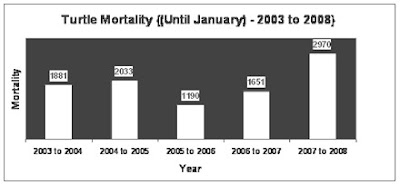
Bhubaneshwar , India — With turtle mortalities due to illegal fishing spiralling out of control, Greenpeace today presented the Orissa government with a clear ‘upper limit’ target for turtle mortality along the coast from Paradip to Chilika. Criticising the government for failing to solve a recurring tragedy, Greenpeace demanded that the funds recently released by the Centre be utilised to undertake effective patrolling to prevent illegal trawling. As of 31st January, 2,970 turtle carcasses have been counted along this stretch of the coast. Greenpeace is challenging the government to reduce the current rate of turtle mortalities by 20%, at the very least until the end of April 2008.
“Even though the resources are now available, it is ironic that the turtle toll until January 31 is almost 3000 in the Paradip–Chilika stretch, a dramatic 76% increase from the average of the previous four turtle seasons. While reducing mortality to zero might not be practical, it is high time the Government of Orissa demonstrates its commitment to protecting its turtles, by setting itself, progressively depreciating annual turtle mortality reduction targets. It must start with what is left of this turtle season. This benchmark would enable the Government’s turtle protection efforts to be evaluated in an objective manner” said Sanjiv Gopal, Oceans Campaigner, Greenpeace India.

Illegal fishing and especially trawling has resulted in the death of over 100,000 turtles over the last decade. Even as illegal fishing in the Devi area continues unabated, the situation in the Gahirmatha Marine Sanctuary remains unknown, with no independent verification of official figures possible. Further, the government is not open to joint efforts on monitoring the mortality of turtles in collaboration with conservation groups and NGOs, as this would reveal shocking levels of turtle casualties on the Orissa coast. While the Government has maintained that annual mortalities from the last three seasons has not exceeded 4000, estimates from several independent agencies place this at a range above 10,000 for every season.
Greenpeace has been monitoring the situation in the current turtle season (2007-2008), from November 2007, to ensure that the resources made available to the Department of Forests and Wildlife are utilized appropriately and effectively. From evidence gathered until January 2008, it is clear that inspite of the required resources being made available, the Government of Orissa is once again failing in it’s responsibility to protect the turtles that throng Orissa’s coastal waters, every year from November to May.

The turtle death toll, along the Paradip to Chilika coast, has already crossed 3000 turtles (until January 31, 2008). Illegal fishing in the Devi area, especially trawling, continues unabated. The situation in the Gahirmatha Marine Sanctuary remains unknown, with no independent verification of official figures possible.

This is greenpeace's act. As a first step, to demonstrate commitment and accountability, towards resources which have been made available to ensure effective patrolling and reduction in the mortalities of turtles from mechanised fisheries and especially trawling, Greenpeace is calling the Government of Orissa and the Department of Forests and Wildlife in particular
• To put in place mechanisms, which would include regular marine patrolling, to ensure that the current rate of mortalities in the Devi region, are reduced.
• By way of an objective evaluation of these efforts, this would imply that the mortalities of Olive Ridley turtles in the devi region does not exceed 3760 for the current season, until April 2008, the current figure until January 2008 being 2970.
• This would mean that the mortality for February, March and April 2008 does not exceed 790 or a drop in mortality by 21%.

As part of it’s ongoing campaign to protect the Olive Ridley Turtles, and the interests of traditional fisher communities, Greenpeace will continue to monitor the situation and await to see how the Government of Orissa responds to this challenge positively, before taking any further action.

Please if you care about conservation of sea turtle, visit greenpeace official website. You can send letter or e-mail to Government of Orissa to support marine conservation and protection for sea turtles. Sea turtles are just not animal, but its are part of our world.

BlogCatalog

Bloggers Unite Bloggers Unite